Fear of Public Speaking? 6 Subconscious Shifts That Actually Work

Hypnosis for public speaking works differently than breathing tips or practice runs. It goes to the subconscious pattern that makes your body react like it is under attack the moment all eyes are on you.
Hypnosis for public speaking works differently than breathing tips or practice runs. It goes to the subconscious pattern that makes your body react like it is under attack the moment all eyes are on you. At the Washington DC Hypnosis Center, serving clients in Bethesda, MD, DC, VA and online, this is exactly the work we do.
You Have Heard the Tips. But Here is the Truth
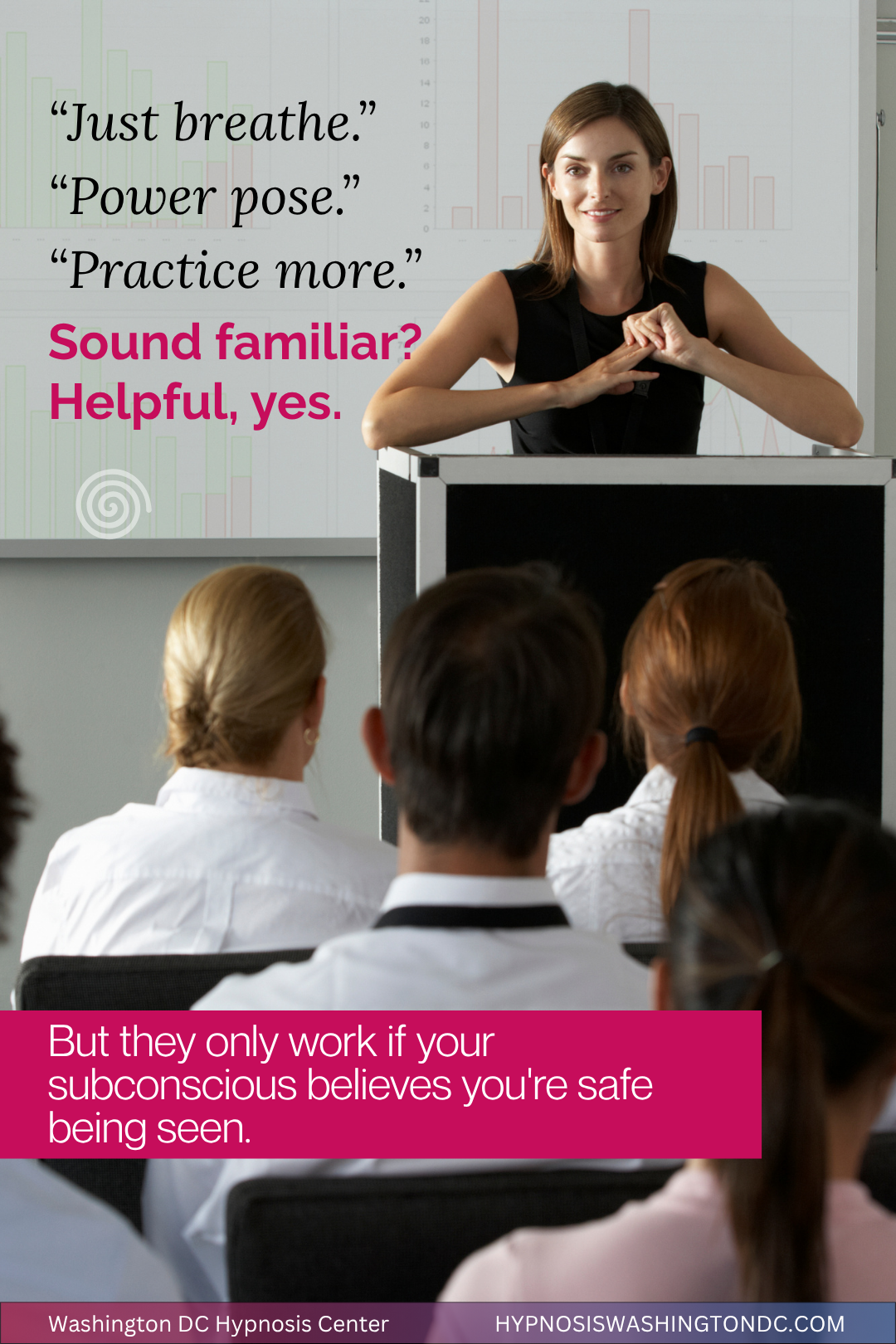
“Just breathe.”
“Power pose before you speak.”
“Practice makes perfect.”
These are the great go-to tips when public-speaking anxiety hits. Practicing breathwork, posture, and being prepared can help in the moment. But if you have ever followed all the advice and still felt like your body and mind were not on the same team the moment you opened your mouth, you are not alone.
In fact, many of us know the feeling all too well:
Your chest tightens with panic. Your head starts to spin. Your thoughts race, and the words you rehearsed to perfection disappear. Sometimes, you even forget to breathe, and your voice cracks as the tension rises. And each time you speak, that familiar ball of anxiety forms deep in your chest, and a voice whispers, “You are not ready.” Or even worse: “Run.”
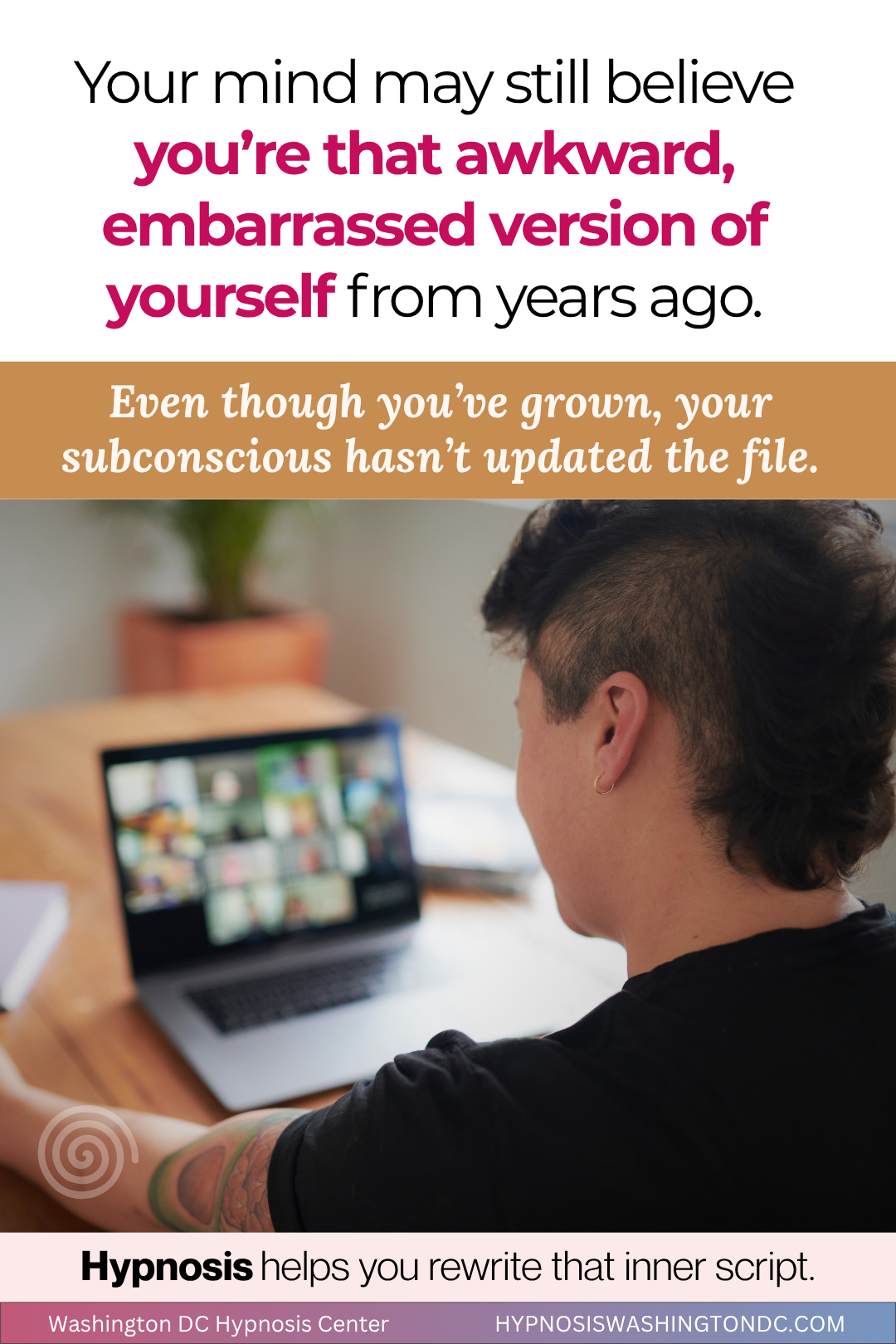
You may not realize it at first, but your mind could still be clinging to an outdated version of you, like an old program that forgot to get updated, that was shaped by old experiences, self-doubt, or past criticism.
And even if you have grown, evolved, and accomplished so much since then, that subconscious image is still running the show when the spotlight turns on.
Here is what no one tells you: This fear lives in your mind, and that is exactly where it can be changed.
The good news is that this fear is not a character flaw. It is a subconscious response pattern, and one that can be rewired.
That is where hypnosis comes in. Read more about hypnosis for confidence ->
Table of Contents
- Why Public-Speaking Anxiety Is So Common
- Why “Mindset Shifts” Do not Stick (Unless You Do This)
- The Inner Critic and Your Subconscious Operating System
- How Hypnosis for Public Speaking Rewires the Fear Response?
- Backed by Science: What the Research Says
- Real Shifts: What Hypnosis for Public Speaking Changes
- What to Expect During a Hypnosis Session
- FAQs: Hypnosis for Public Speaking
- You Do not Need to Force Confidence, You Can Create It
- References



Why Public-Speaking Anxiety Is So Common
Glossophobia, a.k.a. the fear of public speaking, is one of the most common fears in the world. It even outranks the fear of flying spiders, and sometimes even death! Can you believe that?
But why?
Well, it is because public speaking does not just ask you to share ideas; it asks you to be seen.
When the spotlight is turned on and all eyes are looking at you, your survival brain interprets that visibility as a threat. This is not your fault, it is just biology and it can be fixed.
So, the next time you experience:
- Shaky voice
- Racing heart
- Blank mind
- Tight throat
- Burning embarrassment
- Cold sweat
Know that this is called the spotlight response, which is a conditioned stress loop triggered by your subconscious mind. Read more about Hypnosis for Fears and Phobias
Why “Mindset Shifts” Do Not Stick (Unless You Do This)
To assuage this fear, you may have tried:
- Practicing in front of a mirror
- Deep breathing
- Visualization
- Repeating affirmations
- Joining Toastmasters
These are all helpful tools, but they only work if your subconscious already feels safe being seen.
The fact of the matter is that no amount of conscious practice can override a subconscious that still believes speaking = danger.
And that is the core problem.
Until you address the belief system that fuels your fear, your body will keep reacting as if you’re under attack.
The Inner Critic and Your Subconscious Operating System
Think of your subconscious as your operating system. It runs about 90–95% of your daily behavior, and much of it was programmed early in life (experts say by the age of 7).
So, if you were shamed in class, laughed at when you messed up, or silenced as a child, your subconscious likely learned that being seen = being unsafe.
You might consciously want to shine, but your deeper mind is still trying to protect you from danger.
That is why your heart races. That is why you freeze. That’s why you panic.
The good news? You can reprogram the system.
How Hypnosis for Public Speaking Rewires the Fear Response
Hypnosis is a calm and focused state of awareness, similar to meditation or daydreaming, where your conscious mind moves to the side and your subconscious becomes more open to change.
In this state, you’re guided to:
- Access and release past emotional triggers
- Reframe outdated beliefs around visibility, judgment, and self-worth
- Install new patterns of calm, clarity, and confidence
- Mentally rehearse successful speaking experiences so your body knows how to respond when in that situation
Your brain cannot tell the difference between imagined calm and real calm. Therefore, when you experience peace in hypnosis, it becomes your new normal.
Science Behind Hypnosis for Public Speaking
While your fear may feel personal, the mechanism behind it is simply biological, and hypnosis works to lessen this fear because it speaks directly to the emotional brain.
Hypnosis Reduces Performance Anxiety
Hammond (2010) found that hypnosis calms the autonomic nervous system and rewires performance-related fear.
Better Outcomes for Students and Speakers
Stanton (1992) showed that students using self-hypnosis had better test performance and lower anxiety levels.
Brain Imaging Confirms It Works
Oakley & Halligan (2013) found that hypnosis changes activity in the amygdala and emotional centers of the brain.
Hypnosis is Effective for Social Anxiety
Aladdin (2016) showed that hypnosis helps people overcome the fear of being seen, judged, or evaluated.
Real Shifts: What Hypnosis for Public Speaking Changes
After hypnosis, you might notice:
- Less overthinking and spiraling before public speaking
- A more stable voice and grounded presence
- Clearer thinking, even under pressure
- Confidence that does not feel forced
- A feeling of safety in your own body
What to Expect During a Hypnosis Session
At the Washington DC Hypnosis Center, sessions are personalized to your unique story.
You will:
- Identify your specific fear triggers
- Explore the subconscious roots of your problem patterns
- Enter a relaxed hypnotic state
- Rewire your inner script for calm, connection, and clarity
Most of our clients who use hypnosis for public speaking notice meaningful shifts in 1 to 3 sessions. New to Hypnosis Start Here ->
FAQ
You remain awake, aware, and deeply relaxed. During your session at Washington DC Hypnosis Center, you’re guided into a calm, focused state where your subconscious becomes open to positive change. We work with the root cause of your fear not just the surface symptoms so your mind and body can learn a new, calmer response to speaking.
Not at all. Hypnosis gives you more control, not less. You hear every word, stay fully aware, and remain in charge the entire time. You cannot be made to think or do anything you don’t want to.
Yes. Many clients come in with fears originating from childhood experiences, school presentations, embarrassment, criticism, or feeling judged. Hypnosis works because it targets the subconscious program that created the fear, no matter how long it has been active.
Breathing, coaching, and mindset techniques work on the conscious mind the part that knows the fear is irrational.
Hypnosis works on the subconscious, the part responsible for: Freezing, Shaking, Blanking out, Panic, Racing heart, Hypnosis changes the pattern where the fear actually lives.
No. Meditation quiets the mind.
Hypnosis reprograms the mind by guiding you into a receptive state where deeper emotional patterns can be changed. Think of it as meditation with a therapeutic purpose.
No. You only need to be open and willing. Hypnosis works beautifully for analytical, logical, and even skeptical clients. Willingness not belief is what creates results.
Most clients experience noticeable changes in 1–3 sessions, depending on how long the fear has been present and whether additional confidence or performance goals are involved. Some choose to continue for deeper self-esteem or visibility work.
Yes. We focus on retraining your nervous system so you can stay calm, centered, and articulate in any situation team meetings, speaking on Zoom, presentations, job interviews, or public events.
Absolutely. At Washington DC Hypnosis Center, many clients prefer online Zoom sessions, especially if they live in DC, Maryland, or Virginia and want privacy or convenience. Hypnosis works the same because the subconscious responds to the guided process, not the location.
With 17+ years of clinical experience, we specialize in anxiety-related fears, performance blocks, and visibility issues. Sessions are customized, solution-focused, and designed for fast, lasting changes. We serve clients across Washington DC, Rockville, Bethesda, Silver Spring, Arlington, Alexandria, and the greater DMV, as well as online worldwide.
You Do not Need to Force Confidence, You Can Create It
Your fear is not a character flaw. It is just a signal that a part of you needs adjusting.
Hypnosis helps you quiet that old fear pattern and install a new one, one where you feel calm, safe, and fully yourself in front of others.
Ready to speak with confidence, not fear?
Book your free consultation today »
References
- Aladdin, A. (2016). Cognitive Hypnotherapy for Anxiety Disorders: An Integrative Approach to Treatment. Wiley-Blackwell.
- Hammond, D. C. (2010). Hypnosis in the treatment of anxiety- and stress-related disorders. Expert Review of Neurotherapeutics, 10(2), 263–273.
- Oakley, D. A., & Halligan, P. W. (2013). Hypnotic suggestion and cognitive neuroscience. Trends in Cognitive Sciences, 17(10), 605–613.
Stanton, H. E. (1992). Self-hypnosis: A treatment for severe performance anxiety. Australian Psychologist, 27(1), 29–34.