7 Reasons Hypnosis Works When Willpower Does Not
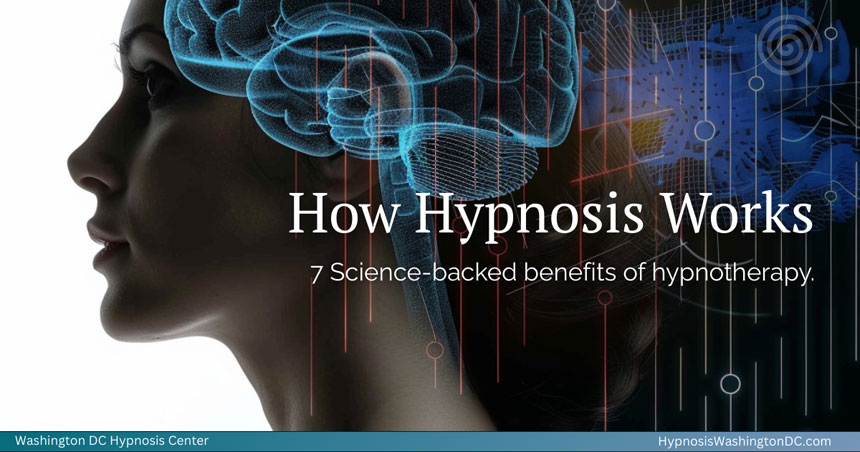
Hypnosis works at the level where habits, beliefs, and patterns actually live: the subconscious mind. These 7 science-backed benefits explain why hypnosis creates lasting change when willpower alone has not been enough. In person in Bethesda, MD, DC, and VA, and online nationwide.
Table of Contents
- How Hypnosis Changes Your Brain Response to Stress??
- How Hypnosis Changes Your Brain Response to Stress
- Quit Smoking More Easily with Hypnosis
- Reduce Anxiety Naturally With Hypnosis
- Support Weight Loss by Rewiring Emotional Eating
- Boost Confidence, Focus, and Motivation
- Tap Into Deep Inner Healing (Even Past Life Regression)
- Sleep Better, Naturally
How Hypnosis Changes Your Brain Response to Stress?
You have probably seen hypnosis done in movies or stage shows, but real, clinical hypnotherapy is something entirely different. Backed by neuroscience and decades of research, it is a powerful way to work directly with your subconscious mind and create lasting change.
Whether you are dealing with anxiety, struggling to sleep, or trying to quit a bad habit–like smoking–these science-backed benefits of hypnosis might just surprise you.
Start here: Beginner’s Guide→
1. How Hypnosis Changes Your Brain Response to Stress


A study from Stanford University found that during a session, brain regions tied to emotional regulation and focus actually shift activity. This helps your brain “recode” stress patterns, leading to reduced anxiety, improved attention, and a calm, relaxed state. In short, this work helps regulate your nervous system and lowers stress in ways that meditation alone might not reach.
If you are thinking of trying hypnosis, here is how to Prepare for Your First Session→
Ongoing stress? See how we help with Stress Relief→
2. Quit Smoking More Easily with Hypnosis
Ready to break free from cigarettes? A University of Iowa meta-analysis found this work to be more effective at helping quit smoking than nicotine patches or gum.
Many clients report feeling little to no cravings after just a few sessions of smoking cessation hypnosis, with no harsh side effects or medications.
Struggling with cravings after you quit? Here is the Surprising Sugar-Nicotine Reason→
Ready to stop for good? Explore our Quit Smoking Hypnosis→
3. Reduce Anxiety Naturally Using Hypnosis
A 2016 study in Cerebral Cortex revealed how hypnosis calms the overactive parts of your brain, reducing anxiety and overthinking.
This means that you can finally quiet that inner critic and feel peace naturally. Hypnotherapy for anxiety is one of the most in-demand uses for clinical hypnotherapy today.
Curious about the brain side of this? Here is How Hypnosis Works in the Brain→
Get targeted support: Hypnosis for Anxiety→
4. Rewire Emotional Eating with Hypnosis for Weight Loss
If you struggle with emotional eating or self-sabotage, this work may be exactly what you have been missing. Research from the Journal of Consulting and Clinical Psychology found that weight loss programs supported by subconscious reprogramming resulted in greater long-term success managing weight and eating habits. Working at this level shifts core beliefs, boosts motivation, and makes healthier choices feel easier to make.
If food feels like comfort more than hunger, start with Emotional Eating and Hypnosis→
Want a structured path? Hypnosis for Weight Loss→
5. Boost Confidence and Focus with Hypnotherapy
Studies show that it boosts self-efficacy, which is your belief in your ability to succeed. Whether you are facing career shifts, public speaking, or decision paralysis, this work helps build mental clarity and motivation.
This is where self-hypnosis techniques can shine, too, empowering you to make mindset shifts between sessions.
Explore mindset, performance, and goal-focused work across sessions: All Hypnosis & Life Coaching
Tap Into Deep Inner Healing (Even Past Life Regression)
Some of the most powerful breakthroughs clients experience involve subconscious exploration, through either inner child healing or past life regression.
These sessions are not about fixing something broken. They are about accessing deeper truths, processing stored emotion, and experiencing emotional release.
Wondering what a session looks like? See What Really Happens During Hypnosis→
Ready to explore? Past Life Regression→
7. Sleep Better, Naturally with Hypnosis
If falling or staying asleep is a nightly struggle, hypnosis for sleep can retrain your brain to relax and rest.
A Harvard study showed that people who practiced sleep hypnosis techniques fell asleep faster, woke up less often, and felt more refreshed upon waking in the morning. And unlike sleeping pills, this work supports natural, restorative sleep.
Practical help for better nights: 7 Proven Benefits of Quality Sleep and Hypnosis for sleep & Insomnia
Final Notes: Hypnosis Is More than Relaxation; It is Transformation
If any of these benefits sparked your interest, you are not alone. This powerful work is no longer just for the mildly curious it is a science-backed tool to be used for real change. Whether you are ready to reduce stress, stop smoking, sleep better, or rewire your habits, hypnotherapy can help you create the life you want.
Explore topics: Weight Loss→, Quit Smoking→, Sleep→, Fear of Flying→, Emotional Eating→, Past Life Regression→
FAQ
No, but they are close cousins. Both calm the mind, but it goes a step deeper by working directly with the subconscious to shift core beliefs and habits.
Yes! Many clients use self-hypnosis techniques in between sessions to reinforce their progress.
Yes, and the research backs it up. Brain imaging studies show that hypnosis changes how regions tied to focus and emotional regulation communicate with each other. That is not relaxation. That is your nervous system learning a new response. The change happens at the subconscious level, which is exactly where habits and automatic reactions live.
Most people notice a shift within the first one to three sessions. Some issues resolve faster than others. Smoking cessation often happens in a single intensive session. Deeper patterns around anxiety, confidence, or weight tend to build over three to five sessions. The first consultation will give you a clearer picture of what to expect for your specific situation.
It is one of the safest tools available for personal change. You remain aware and in control throughout the entire session. Nothing happens without your participation. Clinical hypnosis has been endorsed by the American Medical Association since 1958 and is used in hospitals, therapy practices, and private sessions worldwide.
Anxiety lives in the subconscious as a learned pattern of response. Hypnosis works directly at that level, calming the overactive parts of the brain that keep the alarm system running when there is no real threat. A 2016 study published in Cerebral Cortex confirmed that hypnosis measurably reduces activity in the areas of the brain responsible for anxiety and overthinking.
Most people describe it as the feeling of being deeply relaxed but completely aware. Similar to that state just before you fall asleep, when your body is heavy but your mind is still present. You hear everything. You remember the session. You are not unconscious. You are simply focused in a way that makes the subconscious more receptive to change.
Ready to explore how hypnosis can help you?
Reach out today to learn more about personalized sessions or to have a free consultation. Let your mind begin the change it is been waiting for.
From sleep to stress relief, hypnosis transforms more than you think.
Explore all hypnosis benefits→