Hypnosis vs Meditation: Key Differences and Benefits Explained

Hypnosis vs meditation. Only one works directly with the subconscious to change what the mind does automatically. If you have tried meditation and still feel stuck, that is exactly the gap hypnosis fills. In person in Bethesda, MD, DC, and VA, and online nationwide.
Table of Contents
- Perception and Misconceptions
- Hypnosis vs Meditation: What Is the Real Difference?
- Why Meditation Does not Work for Everyone
- What Makes Hypnosis Effective?
- When to Consider Hypnosis
- Hypnosis vs Meditation: What the Research Says
- Research and Institutions Supporting Meditation and Hypnosis
- FAQ: Hypnosis vs. Meditation
- Conclusion
Perception and Misconceptions
When people hear the word “hypnosis”, what often comes to mind is that it is a form of mind control. The media and entertainment have long shaped this perception, often portraying hypnosis in movies or stage shows as a tool for manipulation or mind-altering power. These sensationalized images have led many to believe that hypnosis is something to fear , that a practitioner can take control of your mind and make you do things against your will.
This misconception often leads to hesitation, with many people worried about losing control or being manipulated, especially when they are unfamiliar with the process.
A Real Session Looks Nothing Like the Movies
I remember one of our very first clients, a smart and successful CEO of a company, who came to us to work on weight reduction. As I guided her into hypnosis, I noticed that she was not fully relaxing and was not following my instructions. I paused the induction (the process of guiding the mind into a hypnotic state) and asked her how she was feeling and what she needed to feel more relaxed.
She hesitated, then confessed that she was embarrassed to tell me, but she could not stop thinking about her purse that she had left on the couch in the room. She was worried that something might happen to it.
So, I suggested she hold the purse between her legs, and then brought a blanket for her to cover both her purse and her legs, leaving her hands free to relax on top.
She nodded and grabbed her purse, visibly relieved and much more comfortable. With that, we were able to then guide her into a deep state of trance, and she fully relaxed.
In her next session, she was prepared for more progress. As she sat down in the chair, I reminded her about her purse. She proudly replied, “I do not need that anymore,” and continued, “I can go even deeper now.”
Why Control Is Never Part of the Process
This experience highlighted something crucial: people have real, personal distractions, and overcoming those first barriers to relaxation is part of the hypnosis process. However, Hypnosis is not about losing control; it is about learning to guide the mind to a peaceful and open state, where transformation can truly happen.
Meditation gets a different reception. It shows up on wellness blogs, social media, and mainstream outlets as:
- A tool for relaxation
- A path to stress reduction
- A safe, self-directed practice
- A sign of self-improvement
No manipulation. No controversy. Just calm.
Hypnosis deserves the same fair look. The reality is just as simple, and just as safe.
“Curious what hypnosis actually feels like? Experience it for yourself in a free online consultation.”


Hypnosis vs Meditation: What Is the Real Difference?
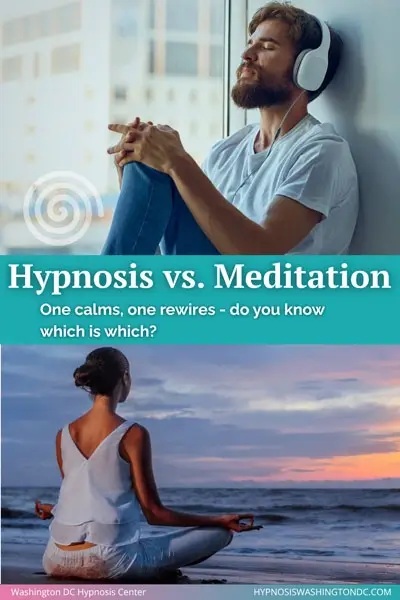
At first glance, meditation and hypnosis may seem similar. Both involve closing your eyes, focusing inward, and relaxing your body. However, they operate on different psychological and neurological mechanisms.
Meditation is a self-directed practice where you aim to observe your thoughts nonjudgmentally. The goal is to build awareness, concentration, or compassion over time. It is all about staying present.
Hypnosis, on the other hand, is a state of focused attention and heightened suggestibility. It allows access to the deeper layers of your subconscious mind. During a hypnosis session, specific suggestions can be made to help shift unwanted behaviors, beliefs, or emotions.
Why Meditation Does not Work for Everyone
Meditation requires the practitioner to stay alert while observing their mind’s activity. This can be challenging for people who:
- Have high anxiety or intrusive thoughts
- Struggle with a busy mind or focus issues
- Feel emotionally disconnected or numb
- Have trauma histories that make stillness triggering
A 2017 meta-analysis in Perspectives on Psychological Science noted that individual differences such as personality traits, mental health conditions, and even brain chemistry play a large role in how effective (or ineffective) meditation is.
“If sitting still feels impossible, hypnosis can guide you past the mental noise into calm focus. Book a free session to see the difference.”
What Makes Hypnosis vs Meditation Different in the Brain?
Hypnosis is supported by growing neuroscientific evidence. For example, MRI scans show that in a hypnotic state, the brain exhibits:
- Increased connectivity between the dorsolateral prefrontal cortex and insula (mind-body awareness and focus)
- Reduced activity in the brain’s “chatter box” (default mode network)
- Heightened suggestibility for encoding new thought patterns and beliefs
In a Stanford University study, Dr. David Spiegel found that hypnosis reduced activity in brain regions tied to self-reflection and rumination, helping bypass the mental noise that can make meditation frustrating.
When to Consider Hypnosis Vs Meditation
If meditation is not delivering clarity, focus, or emotional relief, hypnosis might be the faster path towards attaining those things. In fact, it is particularly effective for:
- Anxiety and stress reduction
- Breaking habits (smoking, overeating, nail-biting, etc.)
- Improving sleep and reducing insomnia
- Pain management (chronic pain, migraines)
- Boosting confidence and overcoming fears
Understanding hypnosis vs meditation helps you choose the right tool for what you are actually trying to change.
“Ready to tackle stress, sleep, or habits? Let us create a personalized hypnosis plan together.”
Hypnosis vs Meditation: What the Research Says
Additionally, Hypnosis is recognized by the American Psychological Association as a legitimate therapeutic tool. It is used by professionals in psychotherapy, dentistry, and even childbirth support.
A meta-analysis in the International Journal of Clinical and Experimental Hypnosis found that hypnosis is especially effective when paired with cognitive-behavioral therapy (CBT) for anxiety, depression, and PTSD.
“Trusted by professionals, tailored for you. Experience the therapeutic power of hypnosis from home.”
Research and Institutions Supporting Meditation and Hypnosis
Meditation Research
- Harvard Medical School: Mindfulness boosts gray matter in regions tied to memory, learning, and emotional control.
Read more - UCLA Mindful Awareness Research Center: Meditation changes brain activity to reduce stress reactivity.
Read more - Johns Hopkins University: Meta-analysis shows mindfulness reduces anxiety, depression, and pain.
Read more
Hypnosis Research
- Stanford University: As mentioned earlier, Dr. David Spiegel’s studies show hypnosis changes brain connectivity, reduces pain, and lowers anxiety.
Read more - University of Iowa: Studies found hypnosis highly effective for chronic pain, IBS, and anxiety.
Read more
Mayo Clinic: Research supports hypnosis for pain management and easing medical procedure side effects.
Read more
“Science shows hypnosis rewires the brain for focus and change. Discover how it can work for you.”
FAQ
No. You remain aware and in control the entire time. You will simply be in a focused, relaxed state.
Both are safe when practiced correctly. Meditation is self-directed while hypnosis is guided, but both are natural states of mind.
Hypnosis can bring noticeable results in just a few sessions. Meditation often requires consistent practice over weeks or months.
Absolutely. Many use meditation for general mindfulness and hypnosis for targeted change.
Yes, research from Stanford, Mayo Clinic, and the University of Iowa confirms its effectiveness for pain, anxiety, and habit change.
Likely, yes. Hypnosis uses guided focus, which can help if silent meditation feels challenging.
Both can help with anxiety. Meditation builds general awareness over time. Hypnosis goes directly to the subconscious pattern driving the anxiety, which is why some of my clients notice a shift much faster with hypnosis. If the anxiety has a specific root, a trigger, a memory, a belief, hypnosis tends to be the more targeted tool.
Close, but not identical. Meditation tends to produce alpha waves, a relaxed and alert state. Hypnosis produces a mix of alpha and theta waves. Theta is a deeper state linked to creativity and subconscious access. That deeper level is part of why hypnosis can shift patterns that meditation alone does not always reach.
Meditation typically takes weeks or months of consistent practice. Some of my clients notice a real shift from hypnosis within one to three sessions. That does not mean hypnosis is magic. It means it works at the subconscious level where change tends to happen faster when the right pattern is found.
Both support better sleep. Meditation helps by calming the mind before bed. Hypnosis goes further by working on what is keeping the mind alert in the first place, whether that is anxiety, racing thoughts, or a stress pattern the nervous system learned to run at night. Some of my clients tried meditation for sleep for months and found hypnosis gave them the first real rest they had in years.
Conclusion
Both hypnosis and meditation are powerful, science-backed tools for personal empowerment and growth. Meditation builds mindfulness and emotional balance over time while hypnosis works quickly to shift behaviors, beliefs, and emotional responses.
And when these two practices are used together—or even individually—they can help you unlock deeper focus, reduce stress, and create lasting change.
“Whether meditation hasn’t worked for you, or you’re ready for deeper change—your subconscious holds the key. Let’s unlock it together.”